Every listing photo of a Federal Heights Tudor sells the same story: leaded glass, a steep gable, the Salt Lake Valley spread out below like it was arranged for the occasion. That story is true. It is also not the reason these homes carry the prices they do.
Talk to anyone who has actually closed on the bench above the University of Utah and a different pattern shows up in the comps. The premium concentrates around one variable that has nothing to do with the roofline: how close the house sits to a walk you can make on foot to the university and its hospital system. That variable is not an accident of taste. It is an accident of military geography from more than a century ago, and as of this month, the fort that created it has been fully absorbed into the university that grew up around it.
The buyer pool tells you where the money actually goes
In the Salt Lake City luxury market, the entry point for what counts as luxury starts near $1.5 million and stretches past $5 million for the largest estates on the upper benches. Federal Heights is consistently named alongside the Upper Avenues, Harvard-Yale, and St. Mary's as one of the neighborhoods producing the most high-end sales in the city. The buyers writing those offers are disproportionately physicians, tech executives from the Silicon Slopes corridor, and out-of-state second-home owners who want airport access without paying Park City prices for it.
That buyer profile is not a coincidence. It is the same profile that would value a fifteen-minute walk to a hospital shift or a faculty meeting over almost any other amenity a house could offer. Homes in Federal Heights sit roughly 25 minutes from the major Wasatch resorts and 15 to 20 minutes from Salt Lake City International, numbers that matter to a relocating executive. But the number that actually explains the price ceiling is the one nobody puts on a flyer: how many minutes on foot to University Hospital.
Above roughly $1.5 million, East Bench inventory also tends to sit longer than the rest of the market, simply because the pool of buyers who want exactly this combination of walkability, architecture, and elevation is small. That is not a market weakness. It is a sign that the premium is doing real work, rewarding a specific kind of proximity rather than a general kind of prestige.
An accident of geography, on purpose
Federal Heights exists because Fort Douglas existed first. When the federal government established the post in the foothills east of the city in the 1860s, officers stationed there wanted to live close to their regimental duties. In the early 1900s they built homesteads on the bench just north of the fort, in what became known as the Lower Heights and the Upper Heights before the two subdivisions merged into the neighborhood we now call Federal Heights. Early developers worked with the sloped site rather than against it, laying out curving streets that produced large, irregular estate lots with real separation between houses, a layout still visible on any plat map of the neighborhood today.
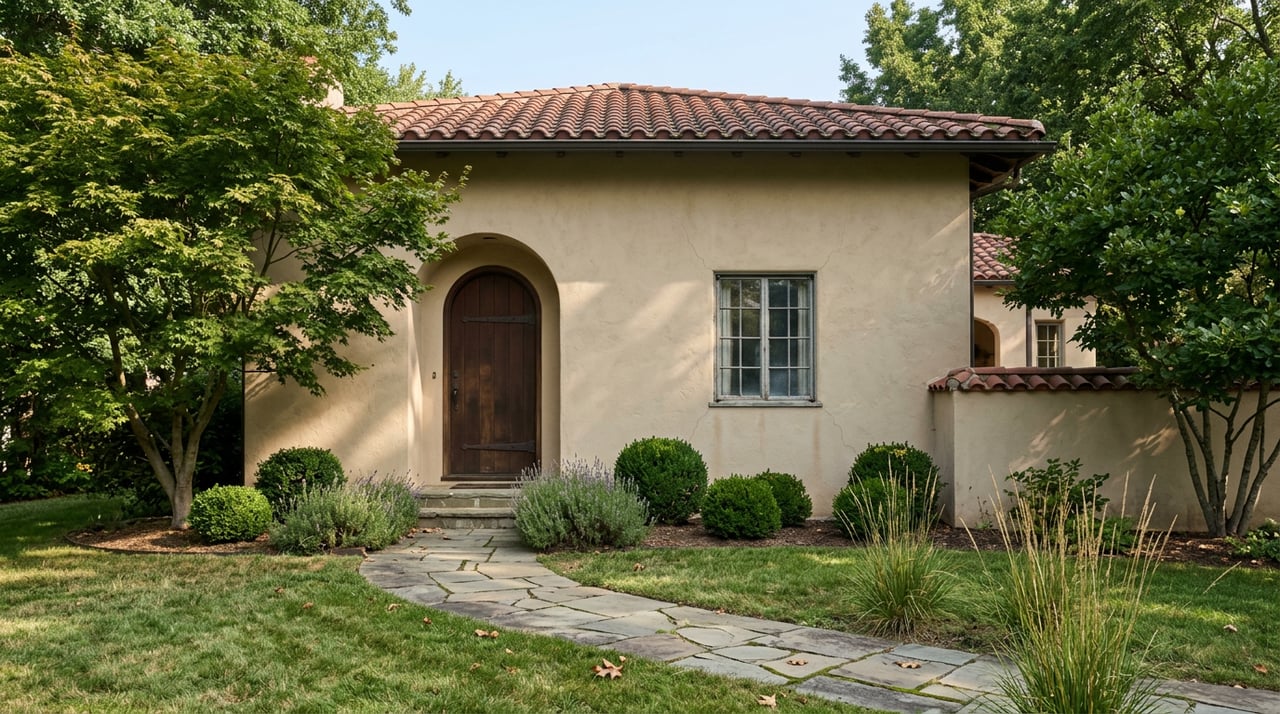
The architecture that followed, mostly Tudor Revival with pockets of Spanish Colonial Revival and English Colonial detail, gave the neighborhood its postcard identity. But the underlying logic was always about the commute. Officers wanted proximity to the post. A century later, physicians and university faculty want proximity to the hospital and the medical school that grew out of that same land. The style changed. The reason for choosing the address did not.
The fort just finished disappearing
A ceremony on August 8, 2026 marked the transfer of the final 50 acres of the historic post from the U.S. Army Reserve to the University of Utah, with formal ownership set to complete on October 1. Before this transfer, the university had already received 1,534 acres of former fort land over the preceding 126 years, in a sequence that reads like a slow-motion absorption: 60 acres in 1898 at the close of the Spanish-American War, land in 1962 for what became the University of Utah Health Hospital, the Spencer Fox Eccles Medical School, the College of Nursing, and the College of Pharmacy, 320 acres in 1968 for Research Park and Red Butte Garden and Arboretum, and 51 acres in 1991 when the fort officially closed. Ahead of the 2002 Winter Olympics, the historic Officers Circle went to the university as well and became Olympic Village housing, now student housing.
The 50 acres transferred this month were the last piece standing, home to the Stephen A. Douglas Armed Forces Reserve Center until its units relocated to a new $127 million, 227,000-square-foot facility at Camp Williams. That new building replaces the functions of nearly a dozen aging structures at the old fort, some more than a century old.
The university has been explicit that historic preservation is part of the deal, not an afterthought. Building 655, constructed in 1863 as the original post commander's residence, is the oldest structure on the University of Utah campus and now operates as a museum. The 1886 stables, built from red sandstone quarried in nearby Red Butte Canyon, are being folded into the same preservation approach. The university's stated position is that historic buildings do not have to be an obstacle to future growth. They can be the argument for it.
The university is now building the premium on purpose
Here is the part that should matter to anyone comparing Federal Heights against other East Bench neighborhoods this year. What officers did by instinct in the early 1900s, the university is now doing by design.
Earlier this year, three 1891 Army cottages at Fort Douglas, originally built for non-commissioned officers with families, reopened as faculty and staff housing after a full restoration led by architect Kevin Zandberg of Method Studio. The buildings were seismically reinforced and thermally upgraded, then handed back to their original purpose: putting university employees within walking distance of their jobs.
That is not an isolated gesture. The university has laid out a broader framework it calls college town magic, aimed at transforming the southeast corner of campus and the remaining Fort Douglas property into a live-work-recreate district built around housing, dining, and wellness space for as many as 14,000 students, with restaurants, a grocery store, and retail among the possibilities under discussion.
For a Federal Heights buyer, this cuts two ways. On one hand, a denser, more amenity-rich university edge sitting directly against the neighborhood's boundary reinforces exactly the kind of proximity that already drives Federal Heights values, more reason for faculty, medical staff, and researchers to want a walkable home nearby. On the other hand, walkability that was once a quiet advantage becomes a more contested one once the university is actively building for it. More student housing and retail traffic pressed against a neighborhood of century-old estate lots is a different daily experience than the one those original officers signed up for.
Neither of those outcomes shows up in an automated home value estimate. Both belong in a conversation with someone who tracks this specific boundary line for a living.
Other friction points before you write an offer
A few practical details tend to surprise buyers moving into Federal Heights from newer subdivisions elsewhere in the valley.
- Lot geometry is irregular by design. The original 1910s plats followed the slope of the hillside rather than a standard grid, which means setbacks, easements, and buildable envelopes vary block by block. Confirm the survey before you plan any addition.
- Short-term rental flexibility is limited. Salt Lake City generally requires owner-occupancy for short-term rentals, which matters if part of your plan involves renting the home out during a slower relocation.
- The buyer pool at the top of the market is thin. Above roughly $1.5 million, homes can take longer to sell simply because fewer buyers are shopping in that band, which cuts both ways at the negotiating table depending on whether you are buying or selling.
A few common questions
Does the Fort Douglas transfer mean new construction is coming right next to Federal Heights? The university's plans focus on housing, research space, and recreation on land the university already controls, not on rezoning adjacent residential blocks. The relevant question for a Federal Heights buyer is how increased activity along that boundary affects traffic and daily character over the next several years, not whether the neighborhood itself will be redeveloped.
Is the walk-to-hospital premium something an appraiser will actually recognize? Appraisals rely on comparable sales, and walk time is not a line item. It shows up indirectly, in which specific blocks command the highest per-square-foot prices and which sit longer on the market. A local comparative analysis that accounts for exact walk distance tells you more than a citywide average ever will.
Should I worry about buying near a construction zone? The 50 acres just transferred have been an active Army Reserve facility until this year, not an empty lot. Any redevelopment will move through the university's own planning process, which has so far emphasized preserving historic structures rather than clearing them.
Federal Heights rewards buyers who understand what they are actually paying for, and that understanding changes as the neighborhood's oldest boundary redraws itself for the first time in over a century. If you are weighing a move here, or trying to figure out what a specific block is worth against everything happening at its edge, Whitney Foley Real Estate can walk the comps and the context with you. Let's find your perfect property.